SALON/Big Bang: NoMan at the Amstelkerk
noman
NOMAN creates installations composed of separate sculptures that are a
distillation of everyday reality. These are abstractions of form,
material and colour, just the elements themselves. The ingredients for
our imagery are drawn from the world around us, but do not refer back to
it; they are part of a new Utopia.
By isolating objects from their functionality and altering their form
(re-tailoring them, as it were) we breathe new life into them, as with
the curtains in the NOSHO project. There is nothing that
alludes to the former use of the drapes and we imbue them with a new
lease of live, giving them a personality and a distinctive identity.
The proportion of the forms to the human scale is highly important
for this personification; they should fit a human being, as it were. The
sculptures therefore suggest the calm, silent presence of a notional
character. This serves as a means for us to encourage the sculptures to
enter into a relationship with the public, but also establishes
relationships between the objects themselves and between the elements
from which they are composed. We do this so that the public can
recognise themselves in this human scale.
These constituent elements imply a common bond, a familiar origin,
and this is what makes the staging complete: in their group formation
the sculptures function like a ‘super-organism’ or tribe that manifests
itself in conjunction with or in antithesis to the public; rather than
repel the public, the installation subsequently integrates them.
The complete installations are evocative of fictitious scenes
featuring abstract characters. The palette and composition propagates an
insistent, ominous atmosphere. The references to what we know and
recognise in the images are fragments, isolated insinuations. By means
of concealment and omission we ratchet up the suspense in this alienated
world. The resulting tension generates a subconscious flux of feelings
in onlookers, putting their senses on alert.
This dark layer plays an important part in our work and we believe
that it is also deployable in media other than sculpture. Proceeding
from this idea we produced a film, The Final Result Should Be Wonderful,
which is an assemblage of suggestive elements and in that regard
continues a line of approach which is similar to that in the rest of our
work. Once again the image comprises a choreographed grouping, in this
case of real people, among whom there is a mutual bond. This bond is
reinforced by the introduction of a deed, namely the action/reaction of
passing on the kiss.
A characteristic feature of the formal idiom we employ is a
multiplicity of materials presented in simple, abstract forms. For
example, the NOCOM installation is composed of 4,000 individual
threads that are fashioned into solid units, transforming the fragility
into powerful, abstract shapes. What we aim to achieve is an aesthetic
that makes the public feel they are involved with a complexity that does
not repel, but is clear-cut, intelligible and orderly. Such complexity
simultaneously implies that there are multiple angles of approach and
observation points. In general the works have no front or rear, nor do
they direct the public to adopt a particular standpoint. Unequivocal
perception does not constitute an interesting or realistic
representation of the world as we experience and perceive it.
The creation of our images stems from an intrinsic, intuitive mode of
collaboration. The abstract language that we employ as a collaborative
duo is one that we mutually and intuitively understand. It is not a
verbal language, given that the aim of our method of working is to break
free of the world as we know it. It is possible for us to communicate
with each other in a visual language through which we understand each
other very clearly. For example, during the development of a work we
both sense when a component might need to be shifted an inch to the
left. For us this indicates that there are certain truths which are
impossible to pin down on rational grounds, which provides the
opportunity to connect with each other spiritually. It is this
connection that we are ultimately seeking to establish with our public
as well: we do not provide them with a narrative and the situation in
which they find themselves is not made explicit. This means that there
is an intuitive exchange of information rather than a rationalised
imparting of information.
NOMAN was founded in 2010 by Lara Tolman and Selina Parr to work together under one name.
July 7, 2014
SALON/Big Bang; Mimi Berlin at the Oude Kerk
SALON/Big Bang; Evolutionary Extravaganza by Mimi Berlin at the Oude Kerk
(photocredits; JW Kaldenbach)
Mimi Berlin member a-MB-iance created the Evolutionary Extravaganza especially for Salon/Big Bang, it’s an installation reminiscent of an ancient and worn down mini laboratory cum museum, in which statuettes of imaginary animals and other life forms are on show. Mimi Berlin’s Evolutionary Extravaganza offers a comprehensive explanation for a broad range of observed phenomena in animal species, such as for instance the Canis Collum Longus (Doggie Longneck), born from the imagination of a-MB-iance and created with the fascination for life in centuries gone by in mind. All the statuettes are unique, signed pieces and are made with vintage-de-luxe found objects.
Left: Ich Will Ein Fisch Im Wasser Sein by Mimi Berlin & Gem Kingdom, 2014/ Right: Canis Collum Longus (Doggie Longneck) (photocredits: courtesy of the artist)
About: Mimi Berlin is a creative collective, based in Amsterdam. Their aim and mission is to inspire each other through fashion, interior, graphic design and art related projects, also to inspire their clients to the best things in life as well. www.mimiberlin.com
(photocredits; JW Kaldenbach) Mimi Berlin member a-MB-iance created the Evolutionary Extravaganza especially for Salon/Big Bang, it’s an installation reminiscent of an ancient and worn down mini laboratory cum museum, in which statuettes of imaginary animals and other life forms are on show. Mimi Berlin’s Evolutionary Extravaganza offers a comprehensive explanation for a broad range of observed phenomena in animal species, such as for instance the Canis Collum Longus (Doggie Longneck), born from the imagination of a-MB-iance and created with the fascination for life in centuries gone by in mind. All the statuettes are unique, signed pieces and are made with vintage-de-luxe found objects.
Left: Ich Will Ein Fisch Im Wasser Sein by Mimi Berlin & Gem Kingdom, 2014/ Right: Canis Collum Longus (Doggie Longneck) (photocredits: courtesy of the artist)
About: Mimi Berlin is a creative collective, based in Amsterdam. Their aim and mission is to inspire each other through fashion, interior, graphic design and art related projects, also to inspire their clients to the best things in life as well. www.mimiberlin.com
Canis Collum Longus (Doggie Longneck)Canis Collum Longus (Doggie Longnec
Canis Collum Longus (Doggie Longneck)
July 6, 2014
SALON/Big Bang: fORS at the Amstelkerk
fORS, Fast Nacht
About: fORS is a dutch label with German roots which makes conceptual clothes, abstract yet wearable, ideally suited for both men and women looking for that one special tough looking piece.
Their designs are based on the vague balance between symmetry and asymmetry with daring, uneven cuts and contrasts.
fORS equals ageless and timeless designs with an extravagant sex appeal.
fORS, Fast Nacht
About: fORS is a dutch label with German roots which makes conceptual clothes, abstract yet wearable, ideally suited for both men and women looking for that one special tough looking piece.
Their designs are based on the vague balance between symmetry and asymmetry with daring, uneven cuts and contrasts.
fORS equals ageless and timeless designs with an extravagant sex appeal.
SALON/Big Bang: Qaina by Siba Sahabi at the Oude Kerk
Siba Sahabi is presenting 'Qaina' (short film) and 'Tarab' (sculptures) - The short film entitled ‘Qaina’ is dedicated to the historical female
dancers who were known as Qainas. They worked as highly-educated slaves
in the courts of the Ottoman Empire and played an important role in
developing oriental dance throughout the centuries.
This project was realized in collaboration with: Sara Toscano (dance), Iván Pérez (choreography), Rutger Zuydervelt/ Machinefabriek (music), Niels van den Top (film direction), Paul Damen (cinematography), Lisa Klappe (photography), Stefanie Zweifel (assistance), and Alexander Spiliopoulos (CAD modeling) (photocredits; JW Kaldenbach)
July 5, 2014
SALON/Big Bang: Crystal Z Campbell at Magazijn
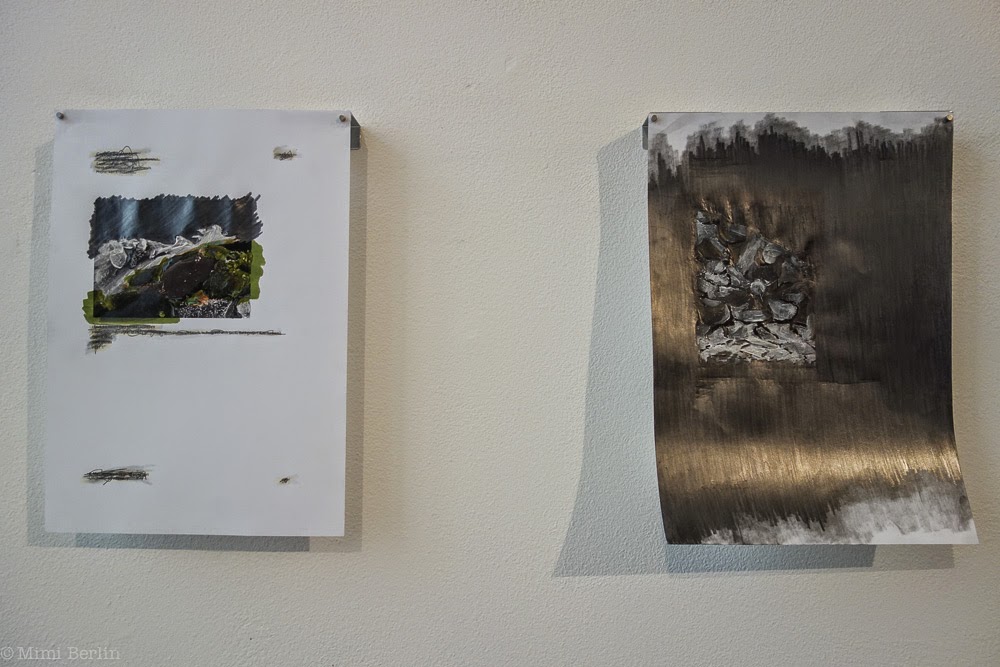
Crystal Z Campbell, False Positives.
Read more about these drawings HERE
About: Crystal
Z Campbell (b. 1980, Prince George’s County, MD) attended Skowhegan
School of Painting & Sculpture, received an MA in Africana Studies
from the University at Albany and an MFA from the University of
California San Diego. Her work has been exhibited at ICA-Philadelphia,
Fondazione Ratti, Studio Museum in Harlem, New Children’s Museum of San
Diego, Wave Hill Garden and Cultural Center, Project Row Houses, Jamaica
Center for Arts and Learning, Harvestworks, Galleria Artericambi and de
Appel Arts Centre among others.
In
2014, Campbell will be a Sommerakademie fellow at Zentrum Paul Klee in
Bern, Switzerland. Campbell was a Van Lier Fellow at the Whitney Museum
of Art’s Independent Study Program and recently finished a two-year
residency at the Rijkakademie van beeldende kunsten in Amsterdam, The
Netherlands where she currently lives and works.
Subscribe to:
Posts (Atom)